|
There's a new AI thing everyone is talking about and that AI folks are trying. Surprise surprise, it has to do with using AI to copy stuff. Today we dive into the "reverse engineer everything" and "decompiling" movement and consider whether it will sloppify everything.
|
|
|
|
|
Every day, data brokers profit from your sensitive info—phone number, DOB, SSN—selling it to the highest bidder. What happens then? Best case: companies target you with ads. Worst case: scammers and identity thieves breach those brokers, leaving your data vulnerable or on the dark web. It's time you check out Incogni. It scrubs your personal data from the web, confronting the world’s data brokers on your behalf. And unlike other services, Incogni helps remove your sensitive information from all broker types, including those tricky People Search Sites. Help protect yourself from identity theft, scam calls, and health insurers raising your rates. Plus, just for 404 Media readers: Get 58% off Incogni using code INCOGNI404
|
|
|
|
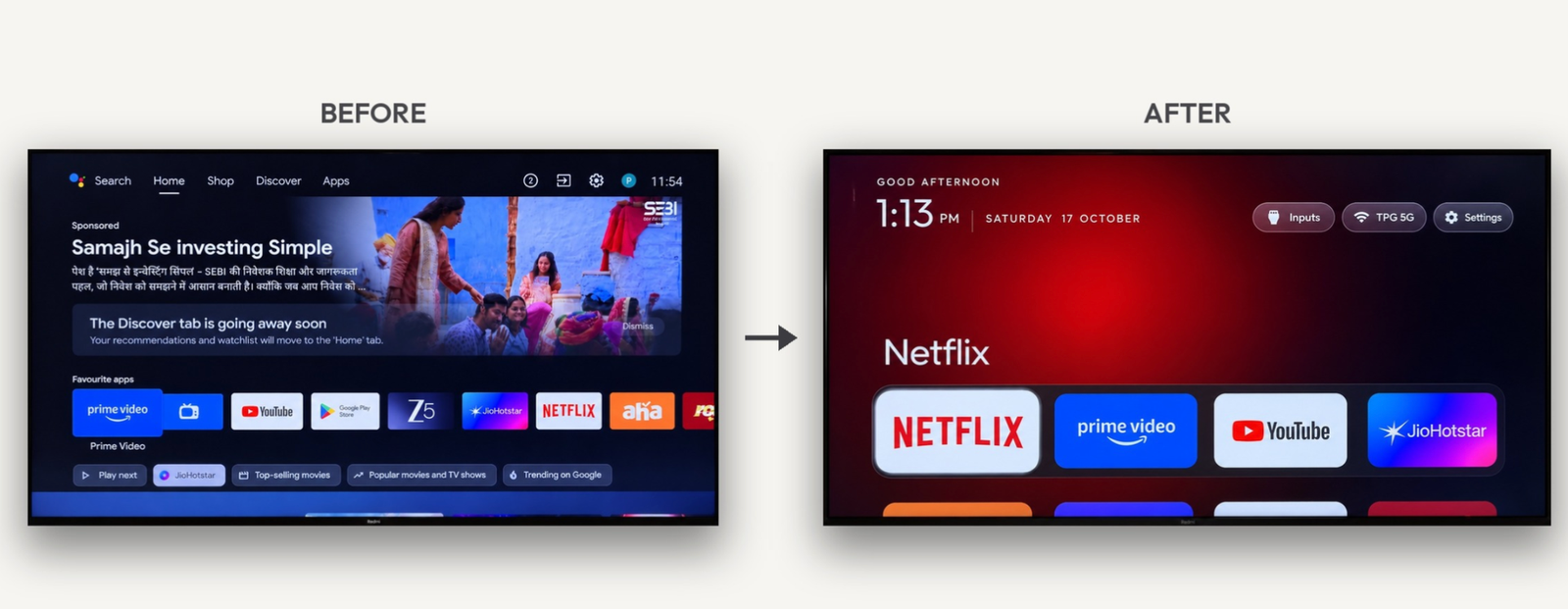 Over the weekend, it became fashionable to use AI to replace the operating systems on smart TVs with vibe coded or AI reverse-engineered ones to make them less bloated. People have taken proprietary internet-of-things devices that were bricked and abandoned by their creators and used AI to hack them and install new software on them, giving functionality the original developers took away. In the last few days I have seen people hack smart picture frames to become AI-powered smart calendars, baby monitors to remove all ads, and bricked Lululemon mirrors to bring them back to life with new software. And dozens and dozens of TVs to install AI-written software that removes bloatware, ads, and simplifies the user interface. What we’re seeing is vibe coding, but instead of making something from scratch, people are using AI to take an existing piece of software and replicate its features, its functionality, or cloning it wholesale. In some cases, people are using AI to take a proprietary piece of hardware and install some version of open source software on it. All of this is some mix of “decompiling,” “reverse-engineering,” “hacking,” vibe coding, AI slop, and stealing. It is the plagiarism machine being used for plagiarism, but also it is random people using AI to take control back over devices whose proprietary software was used to arbitrarily lock away basic functionality, to add advertisements, surveillance, and bloat to devices that probably shouldn’t have them, or whose functionality was bricked altogether. “All I am hearing from software engineers is that software-as-a-service is dying as a business model,” Mike Nolan, who studies the politics of open source software, told 404 Media about the recent spate of AI-driven clones. “It’s becoming so easy to recreate the functionality that you want [with AI.]” “The barrier for recreating this stuff is lower, so a lot of people are doing it for fun,” he added. “But there’s a lot of work associated with maintaining software so there may be a lot of instances where the software may not be reliable enough to use—I don’t know how many companies are going to be adopting these clones.” In one example, a user named Gathin wrote in a post on X: “Vibe coded my parents’ TV this afternoon! It was showing a sponsored ad before you could even get to Netflix. Gave Claude Code the model number, it found the TV on wifi, removed 25 Xiaomi packages and wrote a new launcher.” That post has allegedly been viewed more than 6 million times. “Looks like an Apple TV now lol.” It has been possible to do a lot of this for a long time using open source, human-coded repositories. There are many communities of people who have spent hundreds of hours bringing bricked internet-of-things hardware from the dead or finding vulnerabilities that allow one to modify or repair devices that have proprietary software on them. But over the weekend, a project called “Reverse Engineer Anything” became one of the most viral GitHub repositories in recent memory, with more than 342,000 stars as of the time I’m writing this. The project uses AI to deconstruct features in other pieces of software, and allows the user to replicate them: “See a feature in an app that you want in your own product? Ask your agent to investigate it with REA. It can inspect the app without its source code, explain how the feature works, show the evidence, and build a version for your project.” Read the rest of the article here. More from 404:Busy start to the week for us. Deepfake Sheriff: A Florida police department claims that scammers used AI to clone a sheriff’s voice, with scammers increasingly using voice clones that trick people into thinking they’ve missed jury duty or have a warrant out for their arrest are increasing. Scammers cloned Osceola County Sheriff Steve Moser’s voice and left a voicemail with a resident.  Mahesh Thiagarajan, executive vice president of Oracle Cloud Infrastructure, shows media the Stargate artificial intelligence data center project in Abilene, Texas on Sept. 23, 2025. (AP Photo/Matt O'Brien, File) Data center moratorium moratorium: A group of Texans believe they’ve discovered evidence that the state’s environmental regulatory agency has continued to issue permits to data centers despite Governor Greg Abbott’s call for it to stop. The nonprofits Public Citizen and FracTracker Alliance, working with local activists in Texas, looked through the public database of the Texas Commission on Environmental Quality (TCEQ) and discovered that the organization has worked on multiple permits for data center projects since Abbott called for a pause in the process on September 21. “The TCEQ’s own data indicates that it’s business as usual for data centers and affected communities were promised a freeze. And instead what they’re getting is another reason to distrust the TCEQ and ultimately ineffective attempts to govern by press release,” one expert said. Whoa dude: Scientists discovered a particle that existed at the birth of the universe that “could transform our understanding of cosmic evolution and the fundamental laws of physics.” It’s the heaviest decoupled right-handed neutrino, which may explain why matter has won out over antimatter as the dominant substance in the cosmos.
|
|
|
This segment is a paid ad. If you’re interested in advertising, let's talk. Go to surfshark.com/404Media to get 4 extra months of Surfshark VPN, plus their 30-day money-back guarantee. Because knowing how the system works doesn’t mean you have to be an easy data point in it.
|
|
|
|
Around the web: I’m transfixed by a robbery of roughly $1 million in graded cards from a FedEx truck outside of the PSA headquarters in Santa Ana, California. If you haven’t been paying attention to the Pokemon card or sports trading card hobby, I suggest you check out my article from 2021 about how insane the trading card grading industry has become. Basically, values for Pokemon and sports trading cards have gone through he roof since the pandemic, and the way to ensure authenticity and condition of a card is through professional “grading,” which is where you send the card to a company called PSA who gives the card’s condition a score out of 10, gives it a serial number, and puts it in a sealed plastic case. Highly graded cards are worth many times more than ungraded cards, so PSA and other companies have been bombarded with cards to grade, creating an often months-long backlog. Last week, in a heist, thieves stole hundreds of packages of graded cards from a FedEx truck outside of PSA’s headquarters, which is absolutely roiling the industry and is causing a nightmare for PSA and FedEx. We’re monitoring. Can I have a mile of money: This infographic inspired by the Politizane Wealth Inequality in America YouTube videos (which are absolutely worth your time) is quite harrowing, and shows the difference between “the poor,” “the middle class,” “the rich,” your average billionaire, and Elon Musk through a website scroll that visualizes wealth as hundred dollar bills stacked on top of each other. Someone with $5 million has nearly 18 feet worth of $100 bills. Elon Musk has 543 miles worth of $100 bills. Something needs to change! Drone rescue: Ukraine used a giant drone to rescue a wounded soldier in combat, which is believed to be the first time this has ever happened. I’ve covered drones for a while and have seen various huge drones that claim they can carry people, which always seemed wildly dangerous. Have not seen anything like this before, though. Nathan Fielder talks to WIRED: I haven’t seen You Can See Everything Yet but am fiending to. In the meantime, this spoiler-free Nathan Fielder interview with our friends at Wired made me even more excited for the movie. They Put Doom on VHS: The YouTuber ThroatyMumbo made a wildly fascinating video about trying to port video games to VHS. Wait, what? There’s a catch, in that there is a Raspberry Pi-like device involved, but as Gardiner Bryant points out in a writeup, the VHS tape itself contains the game data, and the VHS tape / player is running the code. It’s wildly impressive and very cool. And yes, there’s Doom. Killswitch is a coding language made by Dominik Picheta that is actively hostile to AI and that LLMs can’t use. Picheta explains: “KillSwitch is an esoteric programming language which is designed to be adversarial to LLMs and coding agents.” The language includes all sorts of things that are designed to fuck with LLMs, which includes “hidden lies which humans are unlikely to read, or which they are likely to recognize as lies. The spec also expects the human reader to deduce certain things, rather than having them explicitly explained,” for example. Farm find: A Chinese rocket deorbited over Minnesota, with part of it falling into a farmer’s cornfield. Zohran talks AI: AI Now Institute and our friends at More Perfect Union held an AI assembly yesterday in which Broad City’s Ilana Glazer interviewed Zohran Mamdani about “a people-first AI agenda.” Lots of other cool/smart people in there as well. I really loved these two pieces in Aftermath. First of all, print games journalism lives. Second, I am a sucker for an esoteric hardware device, in this case a USB-C cord tester. Separately, today I learned that longer USB cords transmit data slower and are finicky with charging. I learned this while trying to send files to my external hard drive on my comically long USB-C cord. Wild!
|